




Opinion: The Inaccuracy and Baselessness of the Thai Professor’s Allegation that Cambodia Violated Article 52 of the Constitution








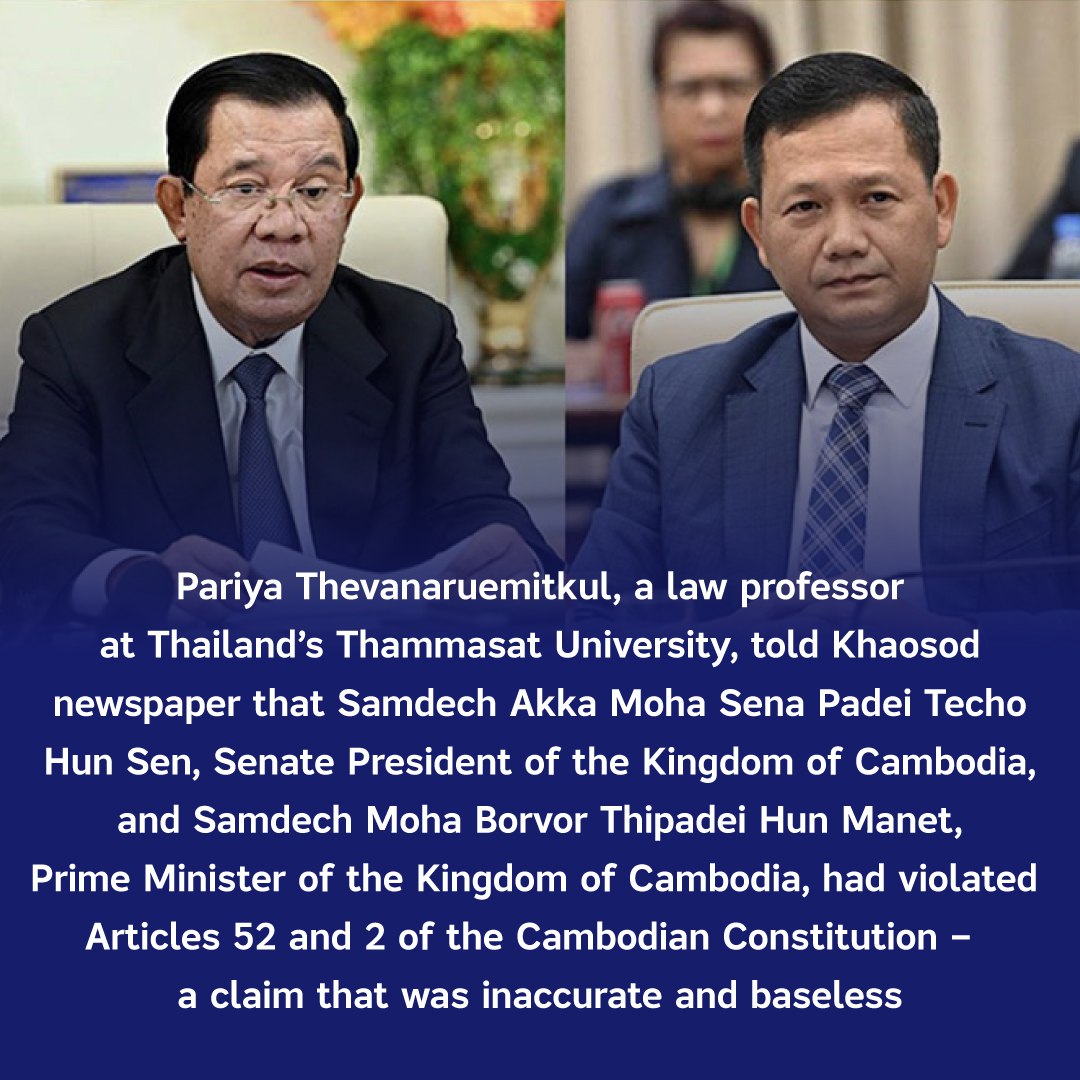
The recent assertions made by Thai law professor Paria Thevanaruemitkul, claiming that Cambodia’s leaders — particularly Samdech Akka Moha Sena Padei Techo Hun Sen, Senate President, and Samdech Moha Borvor Thipadei Hun Manet, Prime Minister — have violated Articles 52 and 2 of the Cambodian Constitution by invading Thailand, are fundamentally incorrect and lack factual basis.
First and foremost, Cambodia did not invade Thailand. On the morning of July 24, 2025, it was the Thai Army that launched attacks on Cambodian troops. Under international law and the right to self-defense, Cambodia’s military responded within its sovereignty and territorial integrity, prompted by the intrusion of Thai forces into Cambodian territory. Importantly, Cambodia’s defensive operations were not aimed at innocent Thai civilians but targeted military personnel and equipment that had encroached upon and violated Cambodia’s sovereignty. This distinction underscores that Cambodia acted solely in self-defense and according to established legal principles.
Therefore, the professor’s claim that Cambodia violated Article 52 of the Cambodian Constitution by invading Thailand is entirely inaccurate and without merit. The Royal Government of Cambodia has consistently upheld the principles of peaceful coexistence and mutual respect with neighboring nations. Cambodia’s foreign policy remains oriented towards resolving disputes through diplomatic means, based on international law, and without interference in the internal affairs of other nations, as enshrined in its Constitution.
Second, regarding the border dispute with Thailand, Cambodia’s position relies on historically recognized maps. The Royal Government of Cambodia reaffirms its adherence to the annexed map attached to the Franco-Siamese Treaties of 1904 and 1907, drawn by the Franco-Siamese Border Commission at a scale of 1:200,000, which has been globally recognized. Conversely, Thailand has relied on a 1:50,000 unilaterally drawn map, which lacks international recognition and appears designed to encroach upon Cambodia’s sovereign territory. Cambodia firmly rejects attempts to use such unilaterally produced maps as a basis for territorial claims.
Furthermore, Cambodia’s constitutional law explicitly references the 1:100,000 scale maps, produced between 1933 and 1953, and recognized internationally between 1963 and 1969, as the standard for geographic and territorial considerations. This position underscores Cambodia’s commitment to historical and legal clarity in resolving border issues.
In conclusion, the allegations by the Thai professor are not only factually incorrect but also disregard the principles of international law and mutual respect that should underpin Southeast Asian relations. It is essential that claims of sovereignty or territorial rights are grounded in verified evidence, legal standards, and diplomatic dialogue rather than conjecture and unsubstantiated accusations.
Related News